Mahama Urges UN Leaders to Back Slavery Resolution and “Stand on the Right Side of History”

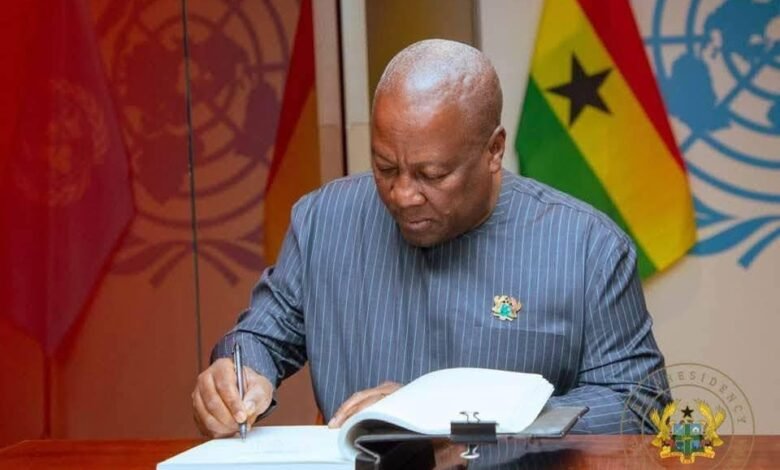
Ghana’s President, John Dramani Mahama, has taken a bold and historic stance on the global stage, urging leaders of United Nations member states to “stand on the right side of history” by supporting a landmark resolution addressing slavery and the transatlantic slave trade. Backed by the African Union, the resolution seeks to formally recognise one of humanity’s darkest chapters and push forward conversations around justice and reparations.
Speaking at high-level engagements around the United Nations, Mahama emphasized that the transatlantic slave trade was not just a historical event, but a defining tragedy whose effects still shape today’s world. He described it as the “gravest crime against humanity,” stressing that its legacy continues to manifest in systemic racism, economic inequalities, and structural disadvantages affecting people of African descent globally.
Mahama’s message to world leaders was clear and morally charged. He called on nations to rise above political hesitation and acknowledge the truth of history. According to him, supporting the resolution is not about assigning blame to present generations, but about accepting historical facts and taking responsibility for their enduring consequences. He framed the moment as a test of moral courage, urging countries to choose justice, truth, and dignity over silence or denial.
At the core of his advocacy is a push for reparatory justice. Mahama argues that recognition alone is not enough. Instead, he believes the international community must move toward concrete actions such as formal apologies, restitution of stolen cultural artifacts, and meaningful socio-economic investments in affected communities. He maintains that these steps are essential to healing historical wounds and building a more equitable global system.
The resolution itself, which has received strong backing from African and Caribbean nations, was ultimately adopted by the United Nations General Assembly with significant global support. Over 120 countries voted in favour, although some major powers opposed or abstained, reflecting ongoing divisions on the issue. Despite this, Mahama and his allies see the adoption as a major symbolic victory and a turning point in the long-running campaign for historical justice.
Mahama has also been vocal about what he perceives as attempts to downplay or erase the history of slavery in some parts of the world. He warned that such actions risk undermining decades of progress in civil rights and historical awareness. For him, confronting the past honestly is not optional—it is necessary for preventing future injustices and fostering genuine global unity.
In outlining his stance, Mahama consistently highlights that the transatlantic slave trade fundamentally shaped the modern global order. He points out that the exploitation of African people contributed significantly to the economic development of other regions, while leaving lasting scars on African nations and their diasporas. Therefore, he insists that justice must go beyond acknowledgment and translate into tangible efforts to correct these imbalances.
Ultimately, Mahama’s call to “stand on the right side of history” is both a challenge and an appeal. It challenges nations to confront uncomfortable truths while appealing to shared human values of fairness and accountability. His leadership on this issue positions Ghana at the forefront of a broader African-led movement demanding recognition, dignity, and justice for millions of people affected by centuries of exploitation.
As global conversations around reparations continue to gain momentum, Mahama’s voice remains a powerful reminder that history is not just about the past—it is about shaping a more just and inclusive future.